
Best AI Bookkeeping For Small Business


Listen to the podcast
Audio version of this article
Best AI Bookkeeping For Small Business
Bookkeeping and accounting firms know the feeling: client books pile up faster than the team can close them. Month-end turns into a 12-day sprint, 1099 deadlines sneak up, and partners are still reconciling last quarter's bank feeds late into the night. It is the repetitive administrative work that fills every gap in the day—the manual follow-ups you cannot hire for fast enough, cannot fully automate with a basic SaaS subscription, and cannot keep doing yourself if you want to scale the firm.
This post is for bookkeeping and accounting firms who are past the "should I add AI" question and are looking for the right way to implement it. The best AI bookkeeping setup for a small business isn't just a generic website chatbot. It is an automated workflow that runs on dedicated hardware, configured once for your firm's specific rules, handling client communication and administrative bottlenecks while your team focuses on high-value billable work.
What "best AI" actually means for bookkeeping and accounting firms
The phrase "best AI" gets thrown around a lot, but most tools marketed to accounting firms are either generic chatbots that do not understand professional financial workflows, or cloud-based AI services that suffer from latency and rate limits exactly when your communication volume spikes during tax season.
A highly reliable setup involves a dedicated AI agent running on a secure hardware gateway in your office. Because it runs locally and independently, it does not share processing resources with public traffic. This means it won't get throttled or experience downtime during peak periods—like the January 1099 rush or the chaotic final weeks of tax season when every client is reaching out at once.
This isn't a simple widget on your homepage or a per-seat add-on to your CRM. It is a workflow engine configured once for your firm's specific hours, your triage rules for urgent client requests, and your internal contact points. Once set up, it runs quietly in the background without daily supervision.
What a bookkeeping and accounting firm's AI looks like in practice
- Client intake and document chasing: The AI texts new clients a secure portal link, follows up automatically on missing bank statements or broken credit card feeds, and escalates unresponsive clients to their assigned bookkeeper.
- Month-end close coordination: The AI emails clients several days before the close with a clear list of outstanding items, follows up gently on missing pieces, and updates the status in your firm's practice management software.
- 1099 and payroll deadline reminders: The AI flags clients requiring 1099-NEC/MISC preparation, sends out W-9 requests, tracks responses, and books the final filing reviews for your senior staff.
- Quarterly estimate follow-ups: The AI contacts clients whose quarterly records remain incomplete close to filing deadlines, schedules brief catch-up calls, and logs the outcomes on your firm's dashboard.
Each of these workflows runs without pulling your staff away from complex client files or interrupting deep-focus work. The agent learns your specific services, deadlines, and client communication rules. After an initial learning period, it recognizes that a client missing urgent documents right before a tax filing deadline requires immediate escalation, while a routine question about a past invoice can be queued for regular business hours.
Why bookkeeping and accounting firms often choose the wrong tools
When looking to automate, many firms initially try solutions that aren't built for professional financial workflows:
- Generic consumer AI assistants: These tools often lack an understanding of professional accounting vocabulary. They may treat terms like "reconciliation," "categorization," and "closing the period" as generic phrases, failing to execute the precise, multi-step follow-through that bookkeeping requires.
- Outsourced admin support: While helpful, human assistants are limited by working hours. If a critical document request goes unanswered on a Friday afternoon, it often sits untouched until Monday, causing the month-end close to slip.
- Generic CRMs with basic AI add-ons: These platforms often charge steep per-user licensing fees, which quickly become expensive for growing firms. Despite the cost, the built-in AI rarely understands the specific compliance deadlines and document-chasing workflows unique to accounting.
A dedicated setup offers a practical alternative. It avoids the security concerns of sharing public cloud resources with sensitive client data, and it is tailored specifically to the operational rhythm of a professional practice.
What a dedicated AI Agent Mini PC setup looks like for your firm
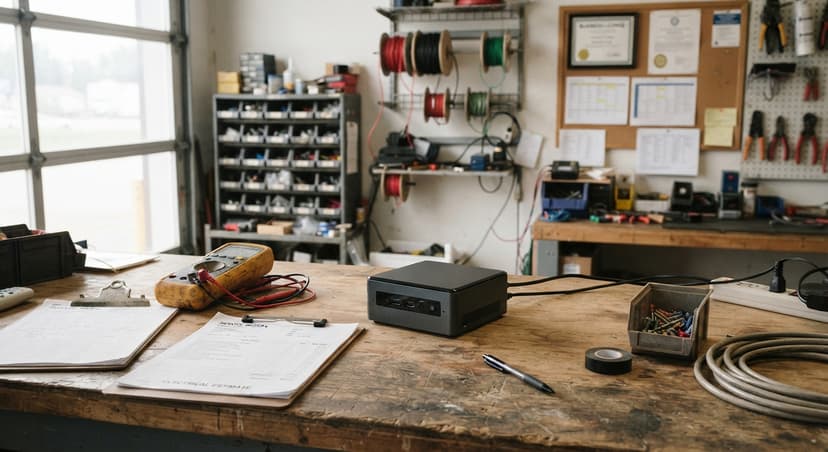
The askingAi.pro AI Agent Mini PC is a compact hardware device—about the size of a paperback book—that sits in your office and runs your AI agent locally, keeping sensitive client interactions separate from your team's day-to-day workstations.
The configuration process is straightforward. You set your service lines, your key filing deadlines, your document-chasing cadences, and your team's escalation contacts.
- Consistent performance: Even during peak filing seasons when cloud-based AI services experience high demand and slow response times, your local agent operates at full speed.
- Predictable operational costs: Your client communication volume can scale significantly during tax season without a corresponding spike in your bill. The cost is tied to a steady monthly support tier rather than variable per-token API usage fees.
- Document and receipt intake: Clients can snap photos of physical receipts, IRS notices, or tax forms and send them via SMS. The agent extracts the relevant information, logs the document, and associates it with the client's account for review.
- Client feedback collection: Shortly after a tax return is filed or a major clean-up project is completed, the agent automatically reaches out to the client to request a review or feedback, routing any immediate concerns directly to the firm's partners.
- Hardware protection and support: Every device comes with a 12-month hardware warranty and access to a support tier tailored to your firm's operational needs.
Setting up the device takes only a few minutes. You connect it to your network, configure your firm's preferences via the dashboard, and let the agent begin managing administrative workflows.
Real workflow example
On Tuesday morning, a partner notices that several clients haven't yet submitted their year-end bank statements. Instead of staff spending hours making individual phone calls, the AI agent (which has already sent automated portal reminders) systematically reaches out to the missing clients. It identifies which clients are ready to upload their documents immediately, schedules brief follow-up calls for those who are traveling, and updates the firm's project tracker. By Wednesday afternoon, the documents are secured, and the closing process starts on schedule—all without requiring manual oversight from senior staff.
This workflow ensures that client communications are handled promptly and professionally. Your clients receive timely support, key deadlines are met, and your team is freed from administrative bottlenecks to focus on higher-value advisory services.
Cost vs. hiring
The typical alternative to automation is hiring administrative support or junior staff to handle client onboarding and document collection. In mid-sized metropolitan areas, these roles represent a significant monthly commitment in salary, benefits, and management overhead.
By comparison, the AI Agent Mini PC paired with a standard support tier represents a predictable, low-overhead alternative. It allows your firm to handle a higher volume of accounts without immediately needing to increase administrative headcount. This approach ensures that when you do make your next hire, you can focus on bringing in qualified accounting professionals who directly generate billable revenue.
Putting it together
The AI Agent Mini PC for bookkeeping and accounting firms is designed to address the specific bottleneck of client data collection and administrative management. It provides a secure, dedicated, and reliable workflow assistant that runs on physical hardware within your control.
To learn more about optimizing your firm's workflows, you can explore the resources and documentation available at https://askingai.pro/blog.
Ready to put AI agents to work?
Order your askingAi AI Agent Mini PC today and start from dedicated, always-on hardware.
Related Articles
Continue exploring AI agents, automation, and small-business hardware.


Become part of our community


Join the many who have already joined our A.i Newsletter.